The Clear Route Through a Room: Why Familiar Layouts Feel Easier to Read
A clear route through a room can make everyday movement easier to anticipate. Learn what to keep consistent and how to adjust the layout around familiar habits.
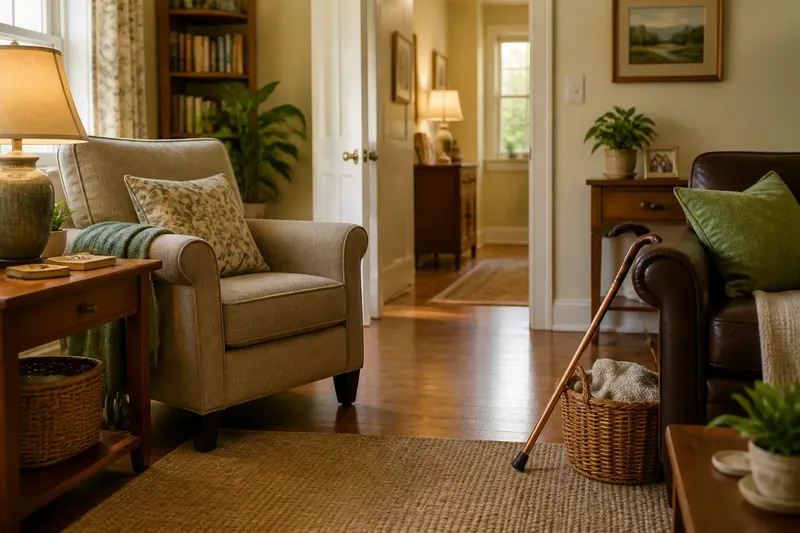
A cane catches on the edge of a basket between the sofa and the doorway. The clear route through a room depends on details like that, as well as on whether the person using it can recognize where to go and turn comfortably.
There is no single layout that suits every household. Start with the person’s habits and the moment that feels difficult, then make only the changes they agree to try.
Start with the difficult moment
Identify the destination and the point where movement becomes uncertain. Someone who loses track of a route may benefit from familiar landmarks, while someone using a cane may need an object moved out of the way.
- If the route is hard to remember: Check whether familiar furniture has shifted. If a landmark has moved, ask whether the person wants it returned; otherwise, keep the current arrangement and consider another cue they prefer.
- If the route feels cramped: Check for baskets, cushions, or small tables in the path. If one narrows the route, ask whether it can be moved; if it belongs there, discuss another route or placement with the person.
- If sitting down or standing up is awkward: Check the chair’s position and nearby support. If either makes the movement harder, ask what adjustment the person wants; if the seat itself remains difficult, seek advice from a qualified professional.
- If the person uses a cane, walker, or wheelchair: Check the approach, turning space, and reach to everyday items. If any part feels difficult, ask the person what to change and consult an occupational therapist when individualized guidance is needed.
- If several people use the room: Check whether a shared route remains clear during everyone’s usual activities. If one person’s adjustment obstructs another’s path, agree on a different placement or a shared arrangement.
- If the person prefers no changes: Check whether a temporary object is causing the problem. If so, ask permission to move that object; if not, respect the preference and leave the room as it is.
More than one issue may be present. Begin with the point where movement most often becomes uncertain rather than rearranging the whole room.
Keep the clear route through a room recognizable
Choose the destinations that matter in ordinary use: a doorway, a favorite chair, a lamp switch, or a nearby room. Trace how the person moves between them, including the approach to a seat and the turn around a coffee table.
Check the route from the person’s usual viewpoint. A path that looks obvious from the doorway may be harder to read from a low chair, especially if an open door, shadow, or object on the floor blends into it.
Familiar furniture can serve as a landmark, but do not assume that restoring an object will help. Say you are considering moving a side table back beside a reading chair after a visit. Ask the person to describe or show what feels different; if they say the table helps them recognize where to turn, return it to that spot and ask whether the turn feels clearer in ordinary use. If they still find the route difficult, consider another adjustment with them rather than treating the table’s return as a solution.
Match the layout to movement and reach
A route includes more than the open floor. It also includes how someone approaches a chair, turns, reaches for a control, and leaves again. Ask what feels awkward, and avoid making an everyday movement feel like an assessment.
For someone using a mobility aid, consider where it can approach, turn, and rest within reach. A walker or wheelchair may need more than a straight path; follow the device instructions and ask a qualified professional for individualized advice if the arrangement is unclear.
Keep frequently used objects, such as glasses, a phone, or a remote, where the person can reach them comfortably. Check whether those objects are being left on the floor; if they are, ask where the person would prefer to keep them and move them there, or choose a different surface together.
Lighting also affects how a route is seen. Check whether the person can reach the relevant switch or lamp from the way they use the room. If lighting or vision remains a concern, ask an eye-care professional about individual needs rather than assuming a brighter bulb is right for everyone.
Make one agreed change at a time
Explain the proposed change and ask the person who lives there what they want. Changing several things together makes it harder to tell which adjustment feels helpful or disruptive.
- Name the destination and the point where movement becomes difficult.
- Ask the person what they notice and whether they want anything changed.
- Choose one movable object or furniture position to address.
- Move it only with the person’s agreement, keeping important belongings visible and reachable.
- Let the person use the route during ordinary activities, then ask whether it feels clearer, less convenient, or unchanged.
- Keep the adjustment only if the person prefers it; otherwise, restore the previous arrangement or discuss another option.
A change can feel different in daylight, after dusk, or while carrying a drink. Ask about the situations that matter in that home, and let the person’s experience guide whether the change stays.
What should stay fixed, and what can move?
Should furniture stay in the same place?
Keep frequently used landmarks stable when the person says they help make the room recognizable. If a change is needed, discuss it first and check how the person responds to the new arrangement.
What should be moved first?
Consider an easy-to-move object that clearly intrudes into the route, such as a basket or occasional table. If moving it requires shifting heavy furniture or altering electrical or household systems, pause and seek qualified help.
How can a room work for someone using a walker?
Check the walker’s approach, turning space, parking place, and access to commonly used items. If any part is difficult, ask the person what they notice and consult an occupational therapist if you need advice tailored to their abilities and home.
What if the person does not want anything moved?
Respect that preference and ask whether there is a small change they would welcome, such as moving a temporary basket. If they want no changes, leave the arrangement alone.
Keep the useful landmarks and skip decorative overwork
A room does not need to look bare to have a clear route. A familiar rug, side table, or collection may matter to the person, so do not remove it simply to make the space look tidier.
Repeatedly shifting decorative pieces or adding elaborate floor markings is not worth the effort if those changes do not address the point where movement becomes uncertain. Focus instead on the doorway, turning points, seating, lighting, and objects that intrude into the route.
If a layout question follows a new mobility limitation, frequent near-falls, or difficulty getting around the home, ask an occupational therapist or another appropriate health professional for guidance. For everyday adjustments, keep the clear route through a room shaped around the person’s habits, movement, and preferences—and let them decide what belongs in their home.